Also in: Português · Español · Italiano · 中文 · हिन्दी
Main points
- Low back pain without a serious injury behind it, called nonspecific, is common, and treatment starts with movement.
- Exercise reduces chronic low back pain, and this has been tested in hundreds of studies.
- There is no magic exercise. Pilates, strength training, core exercises and aerobic exercise all work, and the best one is the one you can stick with.
- Strength training, including the deadlift, can be part of recovery, with progressive loading and guidance.
- Findings on imaging tests are very common in people who feel no pain, and they don’t always explain the symptom.
Strengthening your core helps with low back pain, but no more than other kinds of exercise, and heavy training, including the deadlift, can be part of recovery with guidance. According to data from the Global Burden of Disease study, low back pain has been the leading cause of disability in the world for at least three decades. Almost everyone knows someone who has “thrown out their back,” and many people live in fear that the pain will come back with any movement.
Along with the pain comes the advice: rest, strengthen your core, never lift with a rounded back, stop lifting heavy, and not all of it holds up. I’ll go through what the studies show about each one, with people who train, or want to get back to training, in mind.
When the pain has no serious cause
When there is no serious injury or disease behind the pain to explain it, it is called nonspecific, and this kind of low back pain is very common. The pain is real and can get in the way a lot, but it isn’t usually a sign of serious damage to the spine.
A small share of cases does need investigation. A review that analyzed the most widely used red flags found that many of them help little, but a few carry a lot of weight. For cancer, the most important sign is a history of cancer. For fracture, what counts is older age, long-term corticosteroid use, major trauma, a bruise or scrape on the back and, above all, several of these signs at the same time. Some symptoms call for assessment the same day:
- loss of bladder or bowel control;
- numbness in the area between the legs;
- weakness that keeps getting worse in one or both legs;
- back pain with fever.
Outside these situations, treatment almost always starts with movement. The exception is an athlete under 20 whose pain gets worse when arching the back. A 2022 review shows that spondylolysis, a stress fracture in a vertebra, is common in people who do gymnastics, diving, combat sports or weightlifting, and an athlete like this needs an assessment before going back to training. For runners, I put together the signs that call for a visit in the post on running pain and when to see a doctor.
Staying still doesn’t help
For a long time, rest was the main recommendation for low back pain. A Cochrane review compared advice to rest in bed with advice to stay active. In acute low back pain, people told to stay active had slightly less pain and slightly better day-to-day function. In sciatica, the difference between the two kinds of advice was small or nonexistent.
Current guidelines point the same way. An article in The Lancet’s series on low back pain summed up the recommendations: start with treatments that do not involve medication, with guidance so patients can look after themselves and get back to normal activities and exercise, and use medication, imaging and surgery with caution. The authors also pointed out that, all over the world, rest, imaging, opioids, injections and surgery are still used beyond what the evidence recommends.
Moving within what the pain allows brings a little more relief than rest. Walking, keeping up with daily tasks and adapting your training is usually better than lying down and waiting for the pain to pass.
Imaging: common findings in people without pain
Many people with low back pain get an MRI and come away scared by the report: disc dehydration, disc bulge, protrusion. But these findings also show up in people who feel nothing.
When researchers pooled scans from more than 3,000 people without back pain, these findings showed up very often. Disc degeneration appeared in 37% of 20-year-olds and in 96% of 80-year-olds. Disc bulges appeared in 30% at age 20 and in 84% at age 80. The authors concluded that many of these findings are probably part of normal aging and are not related to pain.
So in most cases imaging isn’t the first step. It comes in when there is a red flag, when there is loss of strength or a neurological change, or when the pain does not follow the expected course. And the report always needs to be read together with the history and the physical exam.
Exercise works, and the type matters less than it seems
A 2021 Cochrane review on exercise for chronic low back pain pooled 249 studies. Compared with no treatment or usual care, exercise reduced pain by about 15 points on a 0 to 100 scale, a difference the authors consider important for the patient. Day-to-day function also improved, but less, and stayed below what the authors consider important.
Two large analyses compared types of exercise with each other in chronic low back pain. In one of them, with 89 studies, Pilates was the most likely to be best for pain, and strength training and stabilization exercises for function. Strength training and aerobic exercise also stood out for mental health. Stretching on its own and the McKenzie method were no different from doing nothing for pain and function.
The other analysis, with 118 studies, reached a similar result: Pilates, strength training, core exercises and mind-body practices were among the best. The programs that worked best had at least 1 to 2 sessions a week of Pilates or strength training, and sessions of under 60 minutes of core, strength or mind-body practices.
The difference between the good types of exercise is small, and the best program is the one you enjoy, can do regularly and keep progressing over time. For aerobic exercise, setting the intensity by training zones helps you progress without overdoing it.
Does strengthening your core fix low back pain?
The core is the group of muscles that stabilizes the trunk: abdominals, back muscles, glutes, diaphragm and pelvic floor. For many years, the idea was that low back pain came from a weak or poorly activated core, and that the solution was to train these muscles in a specific way.
Motor control exercises, which focus on activating the deep trunk muscles, were assessed in a Cochrane review. They worked better than a minimal intervention, but were no better than other types of exercise. The authors concluded that the choice of exercise should probably depend on the preferences of the patient and the professional, the professional’s training, cost and safety.
Can you lift heavy with low back pain?
Many people stop strength training when they have low back pain, for fear of making it worse. A study of 70 people with recurrent low back pain tested this by comparing two 8-week programs, both with pain education. One group did low-load motor control exercises. The other trained the deadlift with heavy loads. Both groups improved in pain, strength and endurance, and there was no difference in pain between them. The motor control group improved more in daily activities and movement control.
The same research group looked at who benefited most from the deadlift. It was the people who started with less pain, less disability and more endurance in the muscles that support the back. Training was supervised by a physical therapist with weightlifting experience.
If you like to train, you don’t have to give up heavy loads during recovery, as long as you have guidance, as in the study. When the pain is still strong, it makes sense to start with lighter loads and exercises that strengthen the back and hips, and to increase the load as the pain allows. The same strength training also helps if you want to lose weight without losing muscle.
Is lifting with a rounded back off limits?
“Never round your back to lift” is one of the most repeated pieces of advice. A 2020 review put this idea to the test: whether bending the lower back more when lifting raises the risk of pain. The evidence, of low quality, did not find that link: bending the spine more was not a risk factor for developing or keeping pain, and it did not tell people with pain apart from people without it. In most studies, there was no difference between the groups.
Technique still matters in training, because it helps you progress the load with control. There’s just no reason to panic if your back rounds a little when you lift something: the studies didn’t show that this causes pain.
How to get back to training after a flare-up
If you train and have had a low back pain flare-up with no red flags, the return usually works better in stages. This is the sequence I recommend:
- In the first few days, keep walking and doing daily tasks, within what the pain allows.
- Go back to training with less load and less volume, starting with the exercises that don’t make the pain worse.
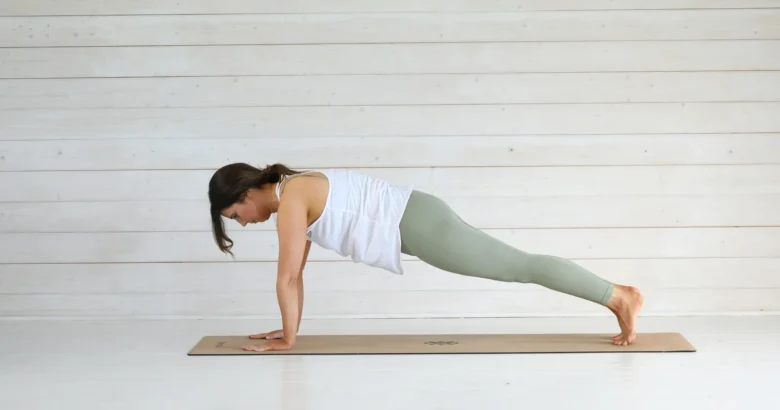
- Include exercises for the back, hips and abdomen, such as bridges, planks and light lifting variations.
- Increase the load gradually, week by week, and notice how your back responds the next day. It’s the same progression logic as returning to running after shin splints.
- Mild pain during training that goes away soon after isn’t a reason to stop. Pain that increases with each session or that travels down the leg is a reason to get reassessed.
Can flare-ups be prevented?
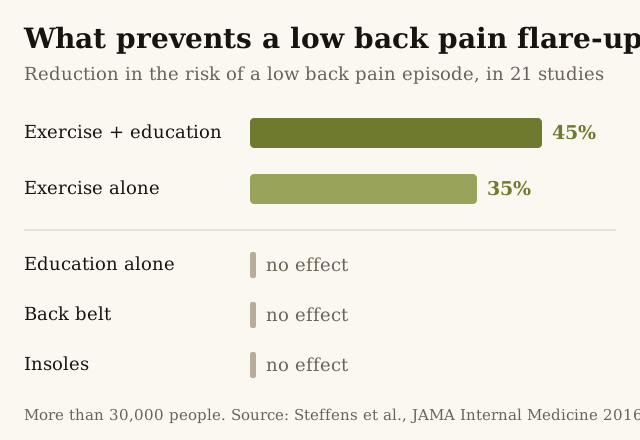
A review of 21 studies with more than 30,000 people looked at what prevents low back pain. Exercise combined with education lowered the risk of an episode of low back pain by 45%. Exercise on its own also seemed to help (a 35% reduction), but with lower-quality evidence. Education alone, back belts and shoe insoles did not prevent pain.
Summary: what to do about low back pain
Low back pain without a serious cause is common, and treatment starts with movement. Exercise works, and the type matters less than regularity: Pilates, strength, core and aerobic exercise are all good options. Lifting heavy can be part of recovery, with progressive loading, and bending the spine when lifting was not shown to be a risk factor. To prevent flare-ups, exercise worked; belts, insoles and education alone did not. And some red flags call for a quick assessment.
Keep your spine moving, and hugs to you all!
Responsible physician: Dr. Gilberto Nering Junior, sports medicine physician, CRM-SP 160822, RQE 142486 (Sports Medicine, Brazil).
This text was not sponsored, is for information only and does not replace an individual assessment. Questions about the content: contact the clinic.
Cover photo: Margaret Young on Unsplash.
Quick questions about low back pain and training
With low back pain, is it better to rest?
In acute low back pain, staying active brings a little more relief and better function than bed rest. Ideally, move within what the pain allows and adapt your training.
What is the best exercise for low back pain?
Pilates, strength training, core exercises and aerobic exercise all work. The difference between them is small, and the best one is the one you can do regularly and progress over time.
Does strengthening the core fix low back pain?
It helps, but it isn’t the only option. Specific core exercises worked better than a minimal intervention, but were no better than other types of exercise.
Can I deadlift with low back pain?
It can be part of treatment, with guidance and progressive loading. In one study, the deadlift improved pain as much as motor control exercises, and worked better in people who started with less pain and more back endurance.
When does low back pain need a scan or urgent assessment?
Loss of bladder or bowel control, numbness in the area between the legs, worsening weakness in the legs or back pain with fever call for assessment the same day. A history of cancer, major trauma or long-term corticosteroid use calls for a consultation to investigate. In other cases, imaging is rarely the first step.
References
- Aasa B, Berglund L, Michaelson P, et al. Individualized low-load motor control exercises and education versus a high-load lifting exercise and education to improve activity, pain intensity, and physical performance in patients with low back pain: a randomized controlled trial. J Orthop Sports Phys Ther. 2015;45(2):77-85. doi:10.2519/jospt.2015.5021
- Berglund L, Aasa B, Hellqvist J, et al. Which Patients With Low Back Pain Benefit From Deadlift Training? J Strength Cond Res. 2015;29(7):1803-11. doi:10.1519/JSC.0000000000000837
- Brinjikji W, Luetmer PH, Comstock B, et al. Systematic literature review of imaging features of spinal degeneration in asymptomatic populations. AJNR Am J Neuroradiol. 2015;36(4):811-6. doi:10.3174/ajnr.A4173
- Dahm KT, Brurberg KG, Jamtvedt G, et al. Advice to rest in bed versus advice to stay active for acute low-back pain and sciatica. Cochrane Database Syst Rev. 2010;(6):CD007612. doi:10.1002/14651858.CD007612.pub2
- Downie A, Williams CM, Henschke N, et al. Red flags to screen for malignancy and fracture in patients with low back pain: systematic review. BMJ. 2013;347:f7095. doi:10.1136/bmj.f7095
- Fernández-Rodríguez R, Álvarez-Bueno C, Cavero-Redondo I, et al. Best Exercise Options for Reducing Pain and Disability in Adults With Chronic Low Back Pain: Pilates, Strength, Core-Based, and Mind-Body. A Network Meta-analysis. J Orthop Sports Phys Ther. 2022;52(8):505-521. doi:10.2519/jospt.2022.10671
- Foster NE, Anema JR, Cherkin D, et al. Prevention and treatment of low back pain: evidence, challenges, and promising directions. Lancet. 2018;391(10137):2368-2383. doi:10.1016/S0140-6736(18)30489-6
- GBD 2021 Low Back Pain Collaborators. Global, regional, and national burden of low back pain, 1990-2020, its attributable risk factors, and projections to 2050: a systematic analysis of the Global Burden of Disease Study 2021. Lancet Rheumatol. 2023;5(6):e316-e329. doi:10.1016/S2665-9913(23)00098-X
- Hayden JA, Ellis J, Ogilvie R, et al. Exercise therapy for chronic low back pain. Cochrane Database Syst Rev. 2021;9(9):CD009790. doi:10.1002/14651858.CD009790.pub2
- Mohile NV, Kuczmarski AS, Lee D, et al. Spondylolysis and Isthmic Spondylolisthesis: A Guide to Diagnosis and Management. J Am Board Fam Med. 2022;35(6):1204-1216. doi:10.3122/jabfm.2022.220130R1
- Owen PJ, Miller CT, Mundell NL, et al. Which specific modes of exercise training are most effective for treating low back pain? Network meta-analysis. Br J Sports Med. 2020;54(21):1279-1287. doi:10.1136/bjsports-2019-100886
- Saraceni N, Kent P, Ng L, et al. To Flex or Not to Flex? Is There a Relationship Between Lumbar Spine Flexion During Lifting and Low Back Pain? A Systematic Review With Meta-analysis. J Orthop Sports Phys Ther. 2020;50(3):121-130. doi:10.2519/jospt.2020.9218
- Saragiotto BT, Maher CG, Yamato TP, et al. Motor control exercise for chronic non-specific low-back pain. Cochrane Database Syst Rev. 2016;(1):CD012004. doi:10.1002/14651858.CD012004
- Steffens D, Maher CG, Pereira LS, et al. Prevention of Low Back Pain: A Systematic Review and Meta-analysis. JAMA Intern Med. 2016;176(2):199-208. doi:10.1001/jamainternmed.2015.7431