Also in: Português · Español · Italiano · 中文 · हिन्दी
Main points
- Zone 2 is an easy intensity at which you can hold a conversation. It sits just below the first threshold, the point where lactate starts to rise in the blood.
- Endurance athletes do most of their training at easy intensity, but they also train hard.
- For losing fat, zone 2 has nothing magical about it. Continuous training and interval training give similar results, and what decides it is consistency and diet.
- Maximum heart rate formulas, such as 220 minus your age, can be quite far off for a specific person.
- The talk test is a simple, validated way to find the easy zone. Heart rate and pace help, each with its own limits.
Zone 2 has become a trend. It shows up in podcasts, on your watch, in the running group’s training plan and in conversations at the gym. Some people swear it is the secret to burning fat, and others say it is what makes elite athletes elite. There are also people who think easy training is a waste of time.
In the post about VO₂ max, I covered how aerobic fitness relates to health. Here I explain what training zones are, what the studies show about zone 2 (and what they do not show) and how to find yours without needing a lab.
What training zones are
As exercise intensity rises gradually, the body goes through two turning points, called thresholds.
At the first threshold, blood lactate starts to rise above resting levels and breathing gets a little heavier. Below it, the effort is comfortable and can be sustained for a long time.
At the second threshold, lactate starts to build up fast and breathing shoots up. Above it, the effort can only be kept up for a short time.
These two points split effort into three bands: easy, below the first threshold; moderate, between the two; and hard, above the second. Many people use a 5-zone scale, which divides those same three bands into smaller parts. On that scale, zones 1 and 2 are in the easy band, zone 3 is between the thresholds, and zones 4 and 5 are in the hard band.
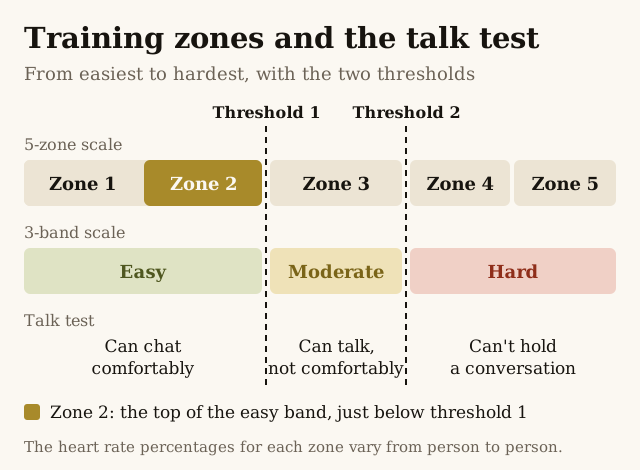
The two scales use the name zone 2 for different things. On the 3-band scale, zone 2 is the moderate band, between the thresholds. On the 5-zone scale, zone 2 is the upper part of the easy band. In a survey of more than 700 coaches and athletes from several countries, the 5-zone scale was the most widely used, and it is the one people usually mean when they say they train in zone 2: a comfortable pace, just below the first threshold.
Why athletes train so much at easy intensity
Researchers who studied the training of top-level endurance athletes found a similar pattern across several sports: about 80% of sessions at easy intensity and about 20% with high-intensity segments, such as interval workouts. This pattern became known as 80/20.
Easy training makes it possible to build up a lot of volume at a stress level the body can tolerate, leaving energy for the hard sessions. Someone who runs marathons or rides for hours could not handle doing everything hard.
There is also no single right distribution. A 2025 analysis pooled studies with recreational and competitive athletes and compared the polarized model, with a lot of easy training and a little very hard training, with the pyramidal model, in which volume decreases from easy to moderate and from moderate to hard. Overall, there was no difference in VO₂ max or performance. In the subgroup analysis, competitive athletes seemed to gain more VO₂ max with the polarized model, and recreational athletes with the pyramidal one.
For the recreational runner, this means most training can be easy, with some moderate work and a smaller share of hard training. What I do not recommend is doing everything at the same medium pace, every day, with no truly easy days.
Does zone 2 burn more fat?
The idea has some truth to it. The amount of fat used as fuel rises from easy to moderate effort and then falls when intensity gets high. In the general population, the peak is around half of VO₂ max; in trained people, close to 60%.
But fat used during a workout is not the same as fat lost from the body over weeks. What determines weight loss is the balance over the whole day and the whole week.
A review of 31 studies compared high-intensity interval training with moderate continuous training. Fat loss was similar with both, and neither one, on its own and over a short period, produced a large reduction. A larger 2024 review found a small advantage for interval training, of less than 1 percentage point of body fat.
Zone 2 is a good tool for losing weight because it is comfortable and you can do it for longer and more often. It has no special fat-burning effect. The best training for losing weight is the one you can keep up, together with your diet, as I explained in the post about the weight loss plateau. Strength training also counts here, because it helps you lose weight without losing muscle.
Zone 2 and mitochondria
Another popular idea is that zone 2 is the best intensity for improving mitochondria, the parts of the cell that produce energy. This idea came from watching elite athletes, who train many hours a week at easy intensity and have excellent mitochondria, a reality very different from that of most people.
A 2025 review looked at this question and concluded that the evidence does not support zone 2 as the ideal intensity for mitochondria or for fat burning by the cell. For people with little time, prioritizing intensities above zone 2 seems to bring more benefit for heart and metabolic health.
Easy training is still the foundation for those who train many hours a week and the safest path for beginners. But people who train only a few hours a week may gain more by adding some harder sessions, with guidance.
Heart rate, pace or feel?
Heart rate
This is the most widely used, but it depends on knowing your maximum heart rate. The best-known formula is 220 minus your age. An analysis that pooled 351 studies, with more than 18,000 people, proposed another one, 208 minus 0.7 times your age, which works better in older people.
These formulas apply to a group average, and a specific person can be quite far from it. A 2025 analysis compared seven formulas in adults who did a maximal test, and in all of them the error for an individual could reach about 18 to 24 beats per minute, too high or too low. For someone who is 40, the formula says 180, but the real maximum could be close to 160 or 200.
And even with a measured maximum, the thresholds do not fall at the same percentage for everyone. A study of more than a thousand people on a treadmill showed that the fitter the person, the higher the percentage of maximum heart rate at which the thresholds appear. A fixed rule, such as “zone 2 is 60 to 70% of max,” works for some people and not for others.
Heart rate also climbs during a long workout, even at the same pace. This is called cardiac drift, and dehydration and heat make the effect larger. On a hot day, the same easy run can show up on your watch as zone 3.
The device matters too. In a 2017 study that compared wrist watches and a chest strap with an electrocardiogram, the strap was practically as accurate as the test. The watches varied a lot: almost all did well on the treadmill, and worse on the bike and the elliptical.
Pace
Pace, which is your speed in minutes per kilometer, is not affected by cardiac drift and works well on a flat, familiar route. But hills, wind, heat, terrain and fatigue change the effort for the same pace. A zone 2 pace on the flat can turn into zone 4 on a hill.
Feel and the talk test
The talk test seems too simple, but it has been validated against thresholds measured in the lab. If you can talk comfortably, you are below the first threshold. If you can still talk, but no longer comfortably, you are close to it. If you cannot speak in sentences, you have reached or passed the second threshold. Rating of perceived exertion, on a scale of 6 to 20, also works: a rating of 10 to 11 corresponds to the first threshold.
In practice, combining them works best. Use feel and the talk test as your main reference, and your watch to confirm and record. Over time, you learn which heart rate and which pace match your zone 2 on a normal day, and you understand why they change on a hot or tired day.
How to find your zone 2 in practice
A simple way to start:
- Do a continuous 20 to 30-minute workout at a pace where you can speak in full sentences, with breathing a little heavier than normal.
- If you need to stop mid-sentence to breathe, slow down.
- Write down your average heart rate and pace for the last 10 minutes, ideally on a cool day and on a flat route.
- Repeat on other days and see whether the numbers stay similar.
If you run and want to increase your volume, zone 2 helps you build up without overloading. Even so, increase gradually, because volume that rises too fast is a common trigger for injury, as I explained in the post about shin splints.
If any symptom appears during exercise, such as chest pain, unusual shortness of breath or palpitations, stop training and get a medical assessment before continuing. If your goal calls for precision, such as an important race, the way to go is measuring instead of estimating. The test that measures thresholds is the cardiopulmonary exercise test (CPET), which shows the ventilatory thresholds, a good approximation of the lactate thresholds.
Conclusion
Zone 2 is easy training at which you can hold a conversation, just below the first threshold. It is the foundation of training for people who do endurance sports, but it has no special fat-burning effect and is not the only intensity that improves health. For weight loss, intensity changes the result very little; what counts is consistency and diet, and harder sessions have their place too. Heart rate formulas can be quite far off, so use the talk test as your guide and your watch as support.
Happy training, and enjoy the chat in zone 2!
Responsible physician: Dr. Gilberto Nering Junior, sports medicine physician, CRM-SP 160822, RQE 142486 (Sports Medicine, Brazil).
This text was not sponsored, is for information only and does not replace an individual assessment. Questions about the content: contact the clinic.
Cover photo: Sweet Life on Unsplash.
Quick questions about zone 2
What is zone 2 training?
It is an easy intensity at which you can hold a conversation, with breathing a little heavier than normal. On the 5-zone scale, it sits just below the first threshold, the point where lactate starts to rise in the blood.
Does training in zone 2 help you lose more weight?
No. Moderate continuous training and interval training produced similar fat loss, with a small advantage, of less than 1 percentage point, for interval training in the larger review. What matters most is consistency and diet.
How do I calculate my zone 2 heart rate?
Formulas only give an estimate, and the error for an individual can reach about 20 beats. The talk test helps you find your range, and a cardiopulmonary exercise test measures your thresholds.
Is it better to use heart rate or pace?
Each has its limits. Heart rate rises with heat, dehydration and long workouts, and pace changes with hills, wind and terrain. Ideally, combine them with how hard the effort feels.
How much of my training should be in zone 2?
Elite endurance athletes do about 80% of their sessions at easy intensity, counting zones 1 and 2 together. For recreational athletes, most training can be easy, with some moderate work and a smaller share of hard training.
References
- Achten J, Jeukendrup AE. Optimizing fat oxidation through exercise and diet. Nutrition. 2004;20(7-8):716-27. doi:10.1016/j.nut.2004.04.005
- Benítez-Muñoz JA, Benito PJ, Guisado-Cuadrado I, et al. Differences in the ventilatory thresholds in treadmill according to training status in 971 males and 301 females: a cross-sectional study. Eur J Appl Physiol. 2025;125(2):499-510. doi:10.1007/s00421-024-05622-z
- Bok D, Rakovac M, Foster C. An Examination and Critique of Subjective Methods to Determine Exercise Intensity: The Talk Test, Feeling Scale, and Rating of Perceived Exertion. Sports Med. 2022;52(9):2085-2109. doi:10.1007/s40279-022-01690-3
- Coyle EF. Cardiovascular drift during prolonged exercise and the effects of dehydration. Int J Sports Med. 1998;19 Suppl 2:S121-4. doi:10.1055/s-2007-971975
- Gillinov S, Etiwy M, Wang R, et al. Variable Accuracy of Wearable Heart Rate Monitors during Aerobic Exercise. Med Sci Sports Exerc. 2017;49(8):1697-1703. doi:10.1249/MSS.0000000000001284
- Keating SE, Johnson NA, Mielke GI, et al. A systematic review and meta-analysis of interval training versus moderate-intensity continuous training on body adiposity. Obes Rev. 2017;18(8):943-964. doi:10.1111/obr.12536
- Martin J, Lindsey B, Gerrity C, et al. Exploratory analysis of the accuracy of age-based maximal heart rate equations across cardiorespiratory fitness levels. PLoS One. 2025;20(10):e0335842. doi:10.1371/journal.pone.0335842
- Poon ET, Li HY, Little JP, et al. Efficacy of Interval Training in Improving Body Composition and Adiposity in Apparently Healthy Adults: An Umbrella Review with Meta-Analysis. Sports Med. 2024;54(11):2817-2840. doi:10.1007/s40279-024-02070-9
- Rosenblat MA, Watt JA, Arnold JI, et al. Which Training Intensity Distribution Intervention will Produce the Greatest Improvements in Maximal Oxygen Uptake and Time-Trial Performance in Endurance Athletes? A Systematic Review and Network Meta-analysis of Individual Participant Data. Sports Med. 2025;55(3):655-673. doi:10.1007/s40279-024-02149-3
- Seiler S. What is best practice for training intensity and duration distribution in endurance athletes? Int J Sports Physiol Perform. 2010;5(3):276-91. doi:10.1123/ijspp.5.3.276
- Seiler-Viken SA, Mentzoni F, Seiler S, et al. Contextualizing the Norwegian standardized intensity zone framework in an international sample of endurance practitioners. Sci Rep. 2025;15(1):34367. doi:10.1038/s41598-025-17023-z
- Storoschuk KL, Moran-MacDonald A, Gibala MJ, et al. Much Ado About Zone 2: A Narrative Review Assessing the Efficacy of Zone 2 Training for Improving Mitochondrial Capacity and Cardiorespiratory Fitness in the General Population. Sports Med. 2025;55(7):1611-1624. doi:10.1007/s40279-025-02261-y
- Tanaka H, Monahan KD, Seals DR. Age-predicted maximal heart rate revisited. J Am Coll Cardiol. 2001;37(1):153-6. doi:10.1016/s0735-1097(00)01054-8
{“@context”: “https://schema.org”, “@type”: “FAQPage”, “inLanguage”: “en”, “mainEntity”: [{“@type”: “Question”, “name”: “What is zone 2 training?”, “acceptedAnswer”: {“@type”: “Answer”, “text”: “It is an easy intensity at which you can hold a conversation, with breathing a little heavier than normal. On the 5-zone scale, it sits just below the first threshold, the point where lactate starts to rise in the blood.”}}, {“@type”: “Question”, “name”: “Does training in zone 2 help you lose more weight?”, “acceptedAnswer”: {“@type”: “Answer”, “text”: “No. Moderate continuous training and interval training produced similar fat loss, with a small advantage, of less than 1 percentage point, for interval training in the larger review. What matters most is consistency and diet.”}}, {“@type”: “Question”, “name”: “How do I calculate my zone 2 heart rate?”, “acceptedAnswer”: {“@type”: “Answer”, “text”: “Formulas only give an estimate, and the error for an individual can reach about 20 beats. The talk test helps you find your range, and a cardiopulmonary exercise test measures your thresholds.”}}, {“@type”: “Question”, “name”: “Is it better to use heart rate or pace?”, “acceptedAnswer”: {“@type”: “Answer”, “text”: “Each has its limits. Heart rate rises with heat, dehydration and long workouts, and pace changes with hills, wind and terrain. Ideally, combine them with how hard the effort feels.”}}, {“@type”: “Question”, “name”: “How much of my training should be in zone 2?”, “acceptedAnswer”: {“@type”: “Answer”, “text”: “Elite endurance athletes do about 80% of their sessions at easy intensity, counting zones 1 and 2 together. For recreational athletes, most training can be easy, with some moderate work and a smaller share of hard training.”}}]}
{“@context”: “https://schema.org”, “@graph”: [{“@type”: “Organization”, “@id”: “https://clinicanering.com/#org”, “name”: “Clínica Nering”, “url”: “https://clinicanering.com”}, {“@type”: “Person”, “@id”: “https://clinicanering.com/#dr-gilberto”, “name”: “Dr. Gilberto Nering Junior”, “jobTitle”: “Sports Medicine Physician”, “identifier”: “CRM-SP 160822 / RQE 142486”, “worksFor”: {“@id”: “https://clinicanering.com/#org”}, “sameAs”: [“https://www.doctoralia.com.br/gilberto-nering-junior”, “https://www.instagram.com/clinica.nering”]}, {“@type”: “MedicalWebPage”, “@id”: “https://clinicanering.com/blog/en/sports-medicine/zone-2-training-zones/#webpage”, “url”: “https://clinicanering.com/blog/en/sports-medicine/zone-2-training-zones/”, “name”: “Zone 2 Training: What It Is and How to Find Yours”, “inLanguage”: “en”, “datePublished”: “2026-11-04T09:00:00+00:00”, “dateModified”: “2026-11-04T09:00:00+00:00”, “author”: {“@id”: “https://clinicanering.com/#dr-gilberto”}, “reviewedBy”: {“@id”: “https://clinicanering.com/#dr-gilberto”}, “publisher”: {“@id”: “https://clinicanering.com/#org”}, “isPartOf”: {“@type”: “WebSite”, “name”: “Clínica Nering Blog”, “url”: “https://clinicanering.com/blog/”}}]}