

Also in: Português · Español · Italiano · 中文 · हिन्दी
Main points
- Lipedema treatment aims to relieve pain and symptoms and to try to keep the condition from getting worse, and it combines diet, exercise and compression.
- Lipedema fat resists dieting, but losing weight relieves symptoms when obesity is also present.
- No diet, supplement or medicine has been proven to treat lipedema itself.
- Exercise in water, walking and yoga are among the recommended activities.
- In a large study, liposuction reduced pain far more than conservative treatment, but the women who had surgery had more serious health problems.
In the first post in the series I explained what lipedema is and how to tell it apart from ordinary fat. The question that comes right after is about lipedema treatment: so what can be done?
There is more than one path, and none of them is a cure. In this post I go through what studies show about diet, exercise, compression stockings, lymphatic drainage, medicines and surgery, including the first large randomized trial of liposuction, published in 2026.
What lipedema treatment aims for
According to the 2026 worldwide consensus, every lipedema treatment aims to relieve symptoms and to prevent or delay worsening. So far, none of them makes the disease go away.
The experts recommend a team with a doctor, a physical therapist, a dietitian and psychological support, according to each woman’s needs, and conservative treatment that combines diet and lifestyle, compression and exercise.
A plan that works for everyone doesn’t exist yet. Stockings, bandages, physical therapy, changes in diet, exercise and surgery have all reduced pain in studies, each with a different size and duration of effect. The choice depends on how severe the condition is, on other diseases and on each woman’s preference. Learning to manage symptoms day to day and having support to deal with body image are also part of treatment.
Diet: what helps and what doesn’t
Lipedema fat resists dieting, but what you eat still counts. When obesity is also present, losing weight relieves symptoms, and the consensus suggests tracking mainly the waist-to-height and waist-to-hip ratios, more than the number on the scale.
A 2026 review on nutrition in lipedema concluded that, today, there is no diet or supplement proven to treat the disease. There are small studies of a few diets, mainly low-carbohydrate ones.
Ketogenic diet
The ketogenic diet, very low in carbohydrates and higher in fat, is the most studied. A 2024 review pooled 7 studies with 329 women with lipedema, who followed this type of diet for about 16 weeks. On average, they lost close to 8 kg and reduced their waist and hips, and their sensitivity to pain dropped a little.
The authors warn that the studies were few, small and of only fair quality, and that the analysis compared the women before and after the diet, not against another diet. An Italian pilot study of the Mediterranean version of the ketogenic diet found fat loss in the legs as well within 10 weeks, including in the group that only followed the diet, but it had few patients.
I see the ketogenic diet as one of the options. It should be monitored, because it isn’t right for everyone, and a plan you give up on quickly does no good.
Supplements
Omega-3, vitamin C, carnitine, chromium and others often come up on websites and in doctors’ offices. The 2026 review and the worldwide consensus agree that the evidence for these products is limited.
Measuring energy expenditure
The same 2026 review points out that weight and BMI are misleading in lipedema and that energy expenditure needs to be calculated carefully. The gold standard for measuring how much the body burns at rest is indirect calorimetry, and for when it isn’t available, researchers have created a formula specific to lipedema. I wrote about this in the post on how many calories the body burns at rest.
Exercise for people with lipedema
The consensus recommends adapted exercise and gives water-based activity, walking and yoga as examples. In water, the pressure probably acts as natural compression on the legs, and buoyancy reduces the impact on the joints. Since heat tends to make swelling worse, a very warm pool isn’t the best choice for training.
In lipedema, exercise aims to maintain mobility, relieve symptoms and help with weight control. Strength training has a place too. A 2026 Brazilian review cites an Italian consensus that puts the emphasis on the legs and calves, because strong muscle helps push lymph along and reduces swelling.
Direct evidence is still thin. The same review describes a study of 22 women in which half did 6 weeks of supervised aerobic and strength training, twice a week. In the group that trained, pain, swelling and strength improved, but the difference from the group that only received advice was not large enough to settle the question.
If you have leg pain or are overweight, you can start in the water or on a bike, which are easy on the joints, and build up the time gradually. If you’re just starting out, it’s worth reading about the difference between moving, training and competing.
Compression and lymphatic drainage
Compression stockings are one of the mainstays of treatment. The consensus says they reduce pain and other symptoms, especially when combined with physical activity. The type and pressure of the stockings are chosen with your doctor, and they can also be worn during exercise.
Manual lymphatic drainage is part of what is called complex decongestive therapy, which combines compression, drainage, exercise, skin care and self-care. The consensus gives a warning: there is no evidence of benefit from drainage on its own, because it has only been studied together with the other parts. Not every patient needs all the components.
The consensus also states that conservative treatment relieves symptoms while it is being done, but the effect doesn’t last if it stops, and there is no proof that it keeps the disease from progressing. That’s why it needs to be kept up.
What about medicines?
So far, no medicine has been proven to treat lipedema. That is what the worldwide consensus says, backed by more than 90% of the experts.
Weight-loss injections, such as semaglutide and tirzepatide, have drawn attention. In a 2026 online survey of 2,719 women with lipedema, more than half were using one of these medicines, most of them because of their weight. Those who used them reported less pain and less swelling than those who had never used them.
But it was a self-report survey: it shows what the women felt, with no randomized group for comparison. Today, the injection makes sense when there is excess weight that needs treatment, and its effect on lipedema still needs to be tested. I wrote about which weight-loss injection works best.
Bariatric surgery doesn’t treat lipedema
Bariatric surgery may be recommended for severe obesity, but it doesn’t treat lipedema. In a group of 13 women described by German doctors, the women lost on average more than 50 kg after surgery, and all of them still had leg pain.
The authors suggest that, when both diseases are present, bariatric surgery should come before lipedema-specific treatment only if diet and exercise have failed, if BMI is above 40 and if the patient knows the pain may persist.
Liposuction: the missing study
The consensus, written before LIPLEG, pointed to the lack of randomized trials on surgery. In 2026, the journal The Lancet published LIPLEG, carried out at 11 centers in Germany.
The trial included 410 women with stage 1 to 3 lipedema and leg pain of at least 4 on a scale of 0 to 10. Before randomization, all of them had conservative treatment for up to 7 months. They were then randomly assigned to have liposuction or to stay on conservative treatment. At 12 months, pain had dropped by at least 2 points in 68% of those who had surgery, compared with 8% of those who stayed on conservative treatment alone. Quality of life also improved more in the surgery group.
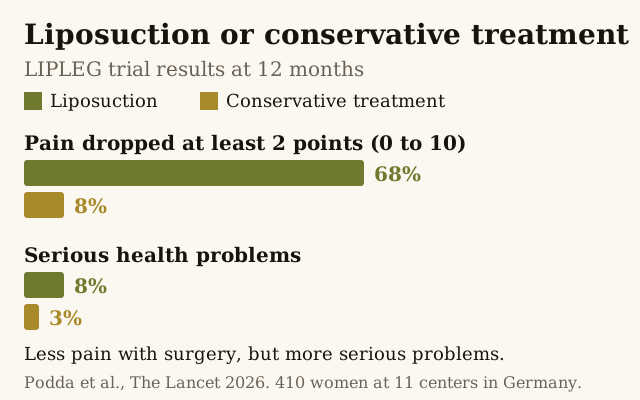
The price showed up in side effects. Almost half of the women who had surgery had at least one, and 8% had serious health problems, compared with 3% in the conservative group. The 3-year follow-up is still under way.
Before LIPLEG, all we had were studies without a comparison group. In one of them, 60 women who had surgery in Germany were followed for 12 years, and the improvement in pain, bruising and swelling held up, with less need for compression and drainage. The surgery didn’t prevent weight changes over that period, up or down.
What the consensus recommends for surgery
- treat obesity and metabolic diseases first, when present;
- use techniques that spare the lymphatic vessels;
- have it done by a surgeon who knows lipedema and conservative treatment well.
The consensus points out that this liposuction is not cosmetic: the goal is to relieve symptoms, and conservative treatment continues afterward.
Summary of the options
| Option | What the studies show |
|---|---|
| Ketogenic diet | Weight loss and smaller measurements in small studies, with no proof that it treats lipedema itself |
| Exercise | Recommended by the consensus, though studies are still small |
| Compression stockings | Reduce pain and symptoms, best combined with physical activity |
| Drainage alone | No evidence of benefit |
| Weight-loss injections | Treat excess weight; their effect on lipedema has not yet been tested in a randomized trial |
| Bariatric surgery | Treats severe obesity, but lipedema pain persists |
| Liposuction | Less pain at 12 months than conservative treatment, with more serious problems |
Conclusion
Lipedema treatment relieves pain and symptoms, but it doesn’t cure. A well-adjusted diet, exercise and compression stockings are the foundation, and losing weight relieves symptoms when obesity is also present. No diet, supplement or medicine treats lipedema itself, and drainage alone has no proven benefit. Liposuction reduced pain far more than conservative treatment in the largest randomized trial done so far, but the women who had surgery had more serious health problems, so the decision needs to be talked through carefully.
Until the next post, everyone!
Responsible physician: Dr. Gilberto Nering Junior, sports medicine physician, CRM-SP 160822, RQE 142486 (Sports Medicine, Brazil).
This text was not sponsored, is for information only and does not replace an individual assessment. Questions about the content: contact the clinic.
Cover photo: Drew Dau on Unsplash.
Frequently asked questions about lipedema treatment
Does the ketogenic diet work for lipedema?
In the studies available, women with lipedema lost weight, reduced their measurements and had slightly less pain on the ketogenic diet. But the studies are small and compared before and after, with no other diet as a control, and it isn’t the only option. The best plan is the one you can stick with.
Does lymphatic drainage fix lipedema?
Not on its own. Drainage is part of complex decongestive therapy, along with compression, exercise and skin care, and the worldwide consensus says there is no evidence of benefit when it is done by itself.
Does liposuction cure lipedema?
It doesn’t cure it, but in the largest randomized trial ever done, 68% of the women who had surgery had a meaningful drop in pain at 12 months, compared with 8% on conservative treatment. Serious health problems were also more common with surgery.
Do weight-loss injections help with lipedema?
They treat obesity, which often comes along with lipedema and makes the symptoms worse. In a 2026 survey, women with lipedema who used these injections reported less pain and swelling, but there is still no randomized trial proving an effect on lipedema itself.
Which exercise is best for people with lipedema?
The worldwide consensus mentions water-based activity, walking and yoga. Strength training also helps maintain muscle. If you have pain or are overweight, you can start in the water or on a bike. What matters most is choosing something that doesn’t increase your pain and that you can do regularly.
References
- Amato ACM, Amato JLS, Benitti DA. The Efficacy of Ketogenic Diets (Low Carbohydrate; High Fat) as a Potential Nutritional Intervention for Lipedema: A Systematic Review and Meta-Analysis. Nutrients. 2024;16(19):3276. doi:10.3390/nu16193276
- Atabilen Pınar B, Çelik MN, Altıntaş Başar HB, et al. Current Evidence-Based Clinical Nutritional Approaches in Lipedema: A Scoping Review. Nutr Rev. 2026;84(8):1736-1755. doi:10.1093/nutrit/nuaf203
- Baumgartner A, Hueppe M, Meier-Vollrath I, et al. Improvements in patients with lipedema 4, 8 and 12 years after liposuction. Phlebology. 2021;36(2):152-159. doi:10.1177/0268355520949775
- Cornely ME, Hasenberg T, Cornely OA, et al. Persistent lipedema pain in patients after bariatric surgery: a case series of 13 patients. Surg Obes Relat Dis. 2022;18(5):628-633. doi:10.1016/j.soard.2021.12.027
- Di Renzo L, Gualtieri P, Zomparelli S, et al. Modified Mediterranean-Ketogenic Diet and Carboxytherapy as Personalized Therapeutic Strategies in Lipedema: A Pilot Study. Nutrients. 2023;15(16):3654. doi:10.3390/nu15163654
- Faria AM, Valerio CM, Barcellos CR, et al. Unraveling lipedema: comprehensive insights and the path to future discoveries. NPJ Metab Health Dis. 2026;4(1):3. doi:10.1038/s44324-025-00093-y
- Kruppa P, Crescenzi R, Faerber G, et al. Lipedema World Alliance Delphi Consensus-Based Position Paper on the Definition and Management of Lipedema: Results from the 2023 Lipedema World Congress in Potsdam. Nat Commun. 2026;17(1):427. doi:10.1038/s41467-025-68232-z
- Podda M, Schmidt J, Cornely ME, et al. Liposuction versus conservative therapy for patients with lipoedema in Germany: a multicentre, randomised controlled clinical trial. Lancet. 2026;408(10558):910-923. doi:10.1016/S0140-6736(26)00910-4
- Srinivasan A, Kartt J, Daftuar F, et al. GLP-1 and GLP-1/GIP receptor agonist medication use and self-reported outcomes in individuals with lipedema: Results from a large online survey. Obes Pillars. 2026;19:100316. doi:10.1016/j.obpill.2026.100316