Also in: Português · Español · Italiano · 中文 · हिन्दी
Main points
- In the studies, a diet chosen by DNA did not lead to more weight loss than a diet that went against the genetic profile.
- Eating at night does not make you gain weight by itself, and a protein snack before bed may even help people who train.
- The carnivore diet still lacks good evidence, and a well-planned vegan diet can provide enough protein.
- High protein did not harm the kidneys of healthy people in studies lasting up to two years. People who already have kidney disease are a different case.
- Superfood is a marketing term with no scientific definition. To live longer and better, what counts is your overall eating pattern, with enough protein, training and time with other people.
This is part 2 of the myths and facts about fad diets, based on the 16 questions in a review published in October 2026 by 25 researchers in the journal of the International Society of Sports Nutrition. In part 1, on calories, fasting and carbs, I covered calories, gaining muscle, fasting and carbohydrates. Here are the other 8 questions, about fad diets, supplements and health.
As in part 1, several authors have ties to sports nutrition and supplement companies, as they themselves state in the author notes. So I checked the abstracts of the main studies and added examples that help explain each answer. Across the 8 questions in this part, DNA diets and superfoods did not hold up in the studies, eating only meat still lacks good evidence, and getting the basics right still paid off.
| Question | What the review says |
|---|---|
| Does a DNA-based diet help you lose more weight? | No, based on what we know today |
| Does eating at night make you gain weight? | Not necessarily; a protein snack may even help people who train |
| Is the carnivore diet good or bad for you? | There is still no good evidence to recommend it |
| Do superfoods exist? | Not as a scientific category |
| Does a vegan diet have enough protein? | Yes, if it is well planned |
| Can food alone cover everything? | In theory, yes; in practice, many athletes cannot manage it |
| Is too much protein bad for the kidneys? | Not in healthy people, in studies of up to two years |
| Is there a diet for living longer and better? | There is a pattern, with enough protein in old age |
9. Does a DNA-based diet help you lose more weight?
No, based on what we know today. The promise of the genetic test is to tell you whether your body responds better to a low-carbohydrate or a low-fat diet.
In a 2023 study, 145 people with overweight or obesity were classified by their DNA as more sensitive to fat or to carbohydrate and randomly assigned to a high-fat or high-carbohydrate diet, which might or might not match their own genetic profile. Among the 122 included in the analysis, over 12 weeks, those on the diet matching their DNA lost 5.3 kg, and those on the opposite diet lost 4.8 kg, with no significant difference.
Another study, lasting one year with 609 people, compared a low-fat diet with a low-carb diet and also tested each participant’s genetic profile. DNA did not help predict who would lose more weight on each diet.
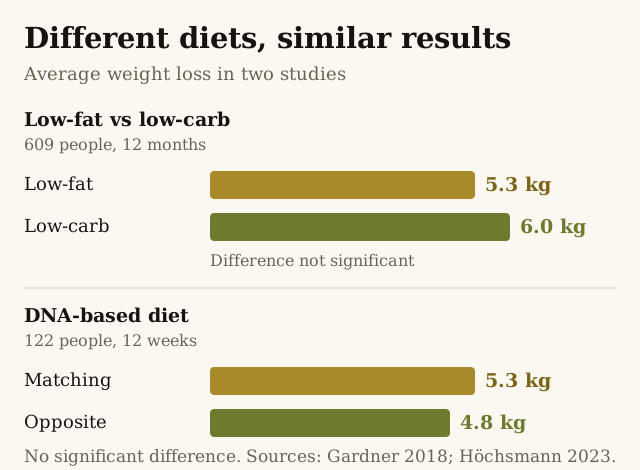
There is no evidence that the genetic diet tests sold today offer any advantage over a well-designed diet. That money may be better spent on follow-up with a nutrition physician or dietitian.
10. Does eating at night make you gain weight?
Eating at night does not make you gain weight by itself. What can get in the way is a large, heavy meal late at night, which can add a lot of calories to your day. But timing, on its own, does not turn food into fat. Your resting metabolism does not switch off during sleep. A small snack before bed does no harm and may even help:
- in a study of 11 active young men, taking 30 g of whey, 30 g of casein or a carbohydrate 30 minutes before bed left resting energy expenditure the next morning slightly higher than with placebo, but, according to the review, another study did not see this difference;
- in 12 men with obesity, a 120-calorie casein snack before bed did not change fat burning overnight;
- in 44 young men doing strength training for 12 weeks, about 27 g of protein before bed brought more strength and more muscle than placebo.
The review suggests that, when it makes sense to eat before bed, a higher-protein snack of up to about 300 calories, with 30 to 40 g of protein, is a good option, such as a protein shake or a generous serving of cottage cheese or high-protein yogurt. It also points out that the type of snack matters: a protein snack is not the same as a pack of cookies.
11. Is the carnivore diet good or bad for you?
There is still no good evidence to recommend it. The carnivore diet excludes all or almost all plant foods, which goes beyond low-carb or ketogenic diets.
The first large study was a social media survey of 2,029 adults who had followed the diet for at least 6 months. Most reported satisfaction and better health, but the data were reported by the participants themselves, with no comparison group. Among those who reported lab results, LDL, the bad cholesterol, was quite high, at around 172 mg/dL.
An analysis of carnivore meal plans designed by researchers showed that, even when well planned, they fell short of recommendations for thiamine, magnesium, calcium and vitamin C, and sometimes iron, folate, iodine and potassium. Fiber was far below the recommendation.
It is also impossible to know whether the improvement some people report comes from the meat or from cutting ultra-processed foods out of their diet. Perhaps it is a bit of both. There are case reports of improvement in inflammatory bowel disease, and the carnivore diet can be a starting point for an elimination and reintroduction diet, with follow-up, but that is not enough to recommend it in general.
12. Do superfoods exist?
“Superfood” is a marketing term with no official scientific definition. Some foods called that have interesting studies behind them, but almost always with concentrated doses. A review of 10 studies showed that tart cherry concentrate, as juice or powder, slightly improved performance in endurance events. For blueberries, the review says most of the data show no clear effect; in a small study of 10 women, a blueberry smoothie taken before and after muscle-damaging exercise sped up the recovery of one type of strength. The review also cites good studies of beetroot juice, which is rich in nitrate, in athletes.
Many of these benefits come from extracts and concentrates, not from the everyday food on your plate. Eating a cherry or a handful of chia will not change your health on its own. Health depends on the whole picture: a varied diet, physical activity, sleep and body composition.
13. Does a vegan diet have enough protein?
A well-planned vegan diet has enough protein. On average, vegans eat less protein than people who eat meat, and the body makes less use of some plant proteins. Soy is an exception: the body uses it about as well as animal protein.
In a 2021 study, over 12 weeks of weight training, 19 vegan young men and 19 omnivores ate the same amount of protein, 1.6 g per kilo per day, topped up with soy protein in the vegans and whey in the omnivores. Both groups gained lean mass and strength in a similar way, with no difference between them. To reach your daily protein as a vegan, it helps to:
- eat larger and more varied amounts of plant sources, such as beans, lentils, chickpeas, soy, tofu, nuts and seeds;
- combine sources, such as rice and beans;
- use plant protein powder, from soy, pea or blends, when food is not enough.
Vitamin B12, iron and zinc also need attention. Vegans need a B12 supplement, and all three call for follow-up with lab tests.
14. Can food alone cover everything?
In theory, food can cover everything, but in practice many athletes and physically active people cannot manage it. In the Netherlands, in a study of 553 elite and sub-elite athletes, most did not reach the average requirement for vitamin D from food alone, and many women ate little iron. Those who used no supplements at all had a higher risk of falling short on several B vitamins, vitamin A, vitamin C and selenium.
Food always comes first. But when your routine, appetite or restrictions do not let the numbers add up, a well-chosen supplement can fill the gap. Protein powder, such as whey protein, and creatine are two examples with good evidence for people who train. Vitamin D and iron depend on lab tests, because too much is also harmful.
15. Is too much protein bad for the kidneys?
In healthy people, the studies have not shown harm, in research lasting from a few weeks to about two years. A 2018 review of 28 studies and 1,358 adults without kidney disease compared higher-protein diets with normal-protein diets. The change in kidney function was no different between the groups.
Some studies looked at people who eat a lot of protein. In a one-year study of 14 men who lifted weights, eating about 2.5 to 3.3 g of protein per kilo per day did not worsen kidney, liver or blood lipid tests. In bodybuilders who ate a lot of protein, kidney function was normal with intakes below 2.8 g per kilo per day.
The increase in filtration that sometimes shows up with more protein is considered a normal adaptation, not a sign of damage. The important exception is people who already have kidney disease. In that case, the amount of protein needs to be adjusted by the doctor. Because early kidney disease causes no symptoms, people with diabetes or high blood pressure should know how their kidneys are doing before raising their protein a lot.
16. Is there a diet for living longer and better?
The studies point to a pattern, not a single diet. Eating plenty of fruit, leafy greens, vegetables, whole grains, legumes, nuts, fish and olive oil, and few ultra-processed foods, is linked to a longer life. An analysis of 29 studies with more than 1.6 million people found about 10% lower risk of death for every 2 points higher on a Mediterranean diet adherence scale, with the caveat that these are observational studies, of low quality according to the authors themselves.
As you age, protein becomes even more important. More than 2,000 people aged 70 to 79 were followed for three years, and the 20% who ate the most protein lost about 40% less lean mass than the 20% who ate the least, in an observational study. An expert group recommends at least 1.0 to 1.2 g per kilo per day for people aged 65 or older, and more for those who train or have an acute or chronic illness, except for people with advanced kidney disease not on dialysis, who may need less.
For older adults with obesity, losing weight with exercise is better than dieting alone. In a one-year study of 107 people over 65, those who combined diet and exercise improved 21% on a physical performance test, compared with 12% with diet alone and 15% with exercise alone. Social connection and support also weigh on longevity, as the review points out at the end.
Fad diet myths and facts: how to use this in practice
If I had to sum up this part 2, it would come down to these six steps. I put them in the order in which I would review a diet:
- Do not spend money on genetic diet tests.
- If you eat at night, choose a small snack with protein.
- Be wary of diets that cut out entire food groups without follow-up.
- If you are vegan, plan your protein and get lab tests.
- Use supplements to round out your diet, with vitamin D and iron only after lab tests.
- With healthy kidneys, eat the protein you need; with kidney disease, diabetes or high blood pressure, get your kidneys checked and follow your doctor’s advice.
Before starting a more restrictive diet, whether carnivore, vegan or long fasting, an assessment is worthwhile. It helps you see what is missing from your plate and which tests to order.
Conclusion
Of the promises in this part, genetic diet tests and superfoods did not stand up to the studies, and the carnivore diet still lacks good evidence. What the studies still support is a varied diet, enough protein for your age and your training, and follow-up when the diet is more restrictive.
Eat well, and take good care of your plate!
Responsible physician: Dr. Gilberto Nering Junior, sports medicine physician, CRM-SP 160822, RQE 142486 (Sports Medicine, Brazil).
This text was not sponsored, is for information only and does not replace an individual assessment. Questions about the content: contact the clinic.
Cover photo: Maarten van den Heuvel on Unsplash.
Quick questions about fad diets and supplements
Does a DNA-based diet work?
In the studies, people who followed the diet matching their own genetic profile did not lose more weight than those who followed the opposite diet. There is no evidence that today’s tests offer any advantage.
Does a snack before bed ruin your diet?
The timing of the snack, on its own, does not make you gain weight. What counts most is your total calories for the day and the type of snack. A protein snack before bed may help people who train.
Is protein bad for the kidneys?
In healthy people, studies lasting up to about two years did not show harm to kidney function. People who already have kidney disease need medical guidance on how much protein to eat.
Can a vegan diet cover your protein needs?
Yes, if it is well planned. In one study, vegans and omnivores eating the same amount of protein gained lean mass and strength in a similar way over 12 weeks of weight training.
Is the carnivore diet bad for you?
There is still no good evidence that the carnivore diet is healthy. Reports of improvement come from surveys with no comparison group, LDL was high in those who reported lab results, and fiber and some nutrients are lacking.
References
- Antonio J, Ellerbroek A, Silver T, et al. A High Protein Diet Has No Harmful Effects: A One-Year Crossover Study in Resistance-Trained Males. J Nutr Metab. 2016;2016:9104792. doi:10.1155/2016/9104792
- Antonio J, Antonio B, Aragon A, et al. Common questions and misconceptions about diets: what does the scientific evidence really show? J Int Soc Sports Nutr. 2026;23(1):2707252. doi:10.1080/15502783.2026.2707252
- Bauer J, Biolo G, Cederholm T, et al. Evidence-based recommendations for optimal dietary protein intake in older people: a position paper from the PROT-AGE Study Group. J Am Med Dir Assoc. 2013;14(8):542-59. doi:10.1016/j.jamda.2013.05.021
- Devries MC, Sithamparapillai A, Brimble KS, et al. Changes in Kidney Function Do Not Differ between Healthy Adults Consuming Higher- Compared with Lower- or Normal-Protein Diets: A Systematic Review and Meta-Analysis. J Nutr. 2018;148(11):1760-1775. doi:10.1093/jn/nxy197
- Gao R, Chilibeck PD. Effect of Tart Cherry Concentrate on Endurance Exercise Performance: A Meta-analysis. J Am Coll Nutr. 2020;39(7):657-664. doi:10.1080/07315724.2020.1713246
- Gardner CD, Trepanowski JF, Del Gobbo LC, et al. Effect of Low-Fat vs Low-Carbohydrate Diet on 12-Month Weight Loss in Overweight Adults and the Association With Genotype Pattern or Insulin Secretion: The DIETFITS Randomized Clinical Trial. JAMA. 2018;319(7):667-679. doi:10.1001/jama.2018.0245
- Goedeke S, Murphy T, Rush A, et al. Assessing the Nutrient Composition of a Carnivore Diet: A Case Study Model. Nutrients. 2024;17(1):140. doi:10.3390/nu17010140
- Hevia-Larraín V, Gualano B, Longobardi I, et al. High-Protein Plant-Based Diet Versus a Protein-Matched Omnivorous Diet to Support Resistance Training Adaptations: A Comparison Between Habitual Vegans and Omnivores. Sports Med. 2021;51(6):1317-1330. doi:10.1007/s40279-021-01434-9
- Höchsmann C, Yang S, Ordovás JM, et al. The Personalized Nutrition Study (POINTS): evaluation of a genetically informed weight loss approach, a Randomized Clinical Trial. Nat Commun. 2023;14(1):6321. doi:10.1038/s41467-023-41969-1
- Houston DK, Nicklas BJ, Ding J, et al. Dietary protein intake is associated with lean mass change in older, community-dwelling adults: the Health, Aging, and Body Composition (Health ABC) Study. Am J Clin Nutr. 2008;87(1):150-5. doi:10.1093/ajcn/87.1.150
- Jäger R, Kerksick CM, Campbell BI, et al. International Society of Sports Nutrition Position Stand: protein and exercise. J Int Soc Sports Nutr. 2017;14:20. doi:10.1186/s12970-017-0177-8
- Kinsey AW, Cappadona SR, Panton LB, et al. The Effect of Casein Protein Prior to Sleep on Fat Metabolism in Obese Men. Nutrients. 2016;8(8):452. doi:10.3390/nu8080452
- Lennerz BS, Mey JT, Henn OH, et al. Behavioral Characteristics and Self-Reported Health Status among 2029 Adults Consuming a “Carnivore Diet”. Curr Dev Nutr. 2021;5(12):nzab133. doi:10.1093/cdn/nzab133
- Madzima TA, Panton LB, Fretti SK, et al. Night-time consumption of protein or carbohydrate results in increased morning resting energy expenditure in active college-aged men. Br J Nutr. 2014;111(1):71-7. doi:10.1017/S000711451300192X
- Mariotti F, Gardner CD. Dietary Protein and Amino Acids in Vegetarian Diets: A Review. Nutrients. 2019;11(11):2661. doi:10.3390/nu11112661
- McLeay Y, Barnes MJ, Mundel T, et al. Effect of New Zealand blueberry consumption on recovery from eccentric exercise-induced muscle damage. J Int Soc Sports Nutr. 2012;9(1):19. doi:10.1186/1550-2783-9-19
- Poortmans JR, Dellalieux O. Do regular high protein diets have potential health risks on kidney function in athletes? Int J Sport Nutr Exerc Metab. 2000;10(1):28-38. doi:10.1123/ijsnem.10.1.28
- Snijders T, Res PT, Smeets JS, et al. Protein Ingestion before Sleep Increases Muscle Mass and Strength Gains during Prolonged Resistance-Type Exercise Training in Healthy Young Men. J Nutr. 2015;145(6):1178-84. doi:10.3945/jn.114.208371
- Soltani S, Jayedi A, Shab-Bidar S, et al. Adherence to the Mediterranean Diet in Relation to All-Cause Mortality: A Systematic Review and Dose-Response Meta-Analysis of Prospective Cohort Studies. Adv Nutr. 2019;10(6):1029-1039. doi:10.1093/advances/nmz041
- Villareal DT, Chode S, Parimi N, et al. Weight loss, exercise, or both and physical function in obese older adults. N Engl J Med. 2011;364(13):1218-29. doi:10.1056/NEJMoa1008234
- Wardenaar F, Brinkmans N, Ceelen I, et al. Micronutrient Intakes in 553 Dutch Elite and Sub-Elite Athletes: Prevalence of Low and High Intakes in Users and Non-Users of Nutritional Supplements. Nutrients. 2017;9(2):142. doi:10.3390/nu9020142