
Also in: Português · Español · Italiano · 中文 · हिन्दी
Main points
- VO₂ max is the largest amount of oxygen your body can take in and use during maximal effort. It is the measure of your aerobic fitness.
- It is one of the health markers most closely linked to living longer. In studies, people with the lowest fitness die earlier than those with the highest.
- VO₂ falls with age, and the decline speeds up in later decades. Training means you start from a higher level.
- The biggest gain comes from leaving a sedentary life behind. Interval training gives a bit more result in less time, but continuous training also works.
- The test that truly measures it is cardiopulmonary exercise testing. Your watch’s number is useful for tracking the trend, but it does not replace the value measured in the test.
Many people first heard of VO₂ max from their watch. The device shows a number after runs, compares it with people your age and sometimes says you have the fitness age of someone younger. That number matters well beyond sport. I will explain what it is, what studies show about it and health, how to measure it and what to do to raise it.
What VO₂ max is
VO₂ stands for volume of oxygen. VO₂ max is the largest amount of oxygen the body can take in, transport and use per minute, at the hardest effort you can sustain. It is measured in milliliters of oxygen per kilogram of body weight per minute (mL/kg/min).
That oxygen goes through a chain of steps:
- The lungs take oxygen from the air.
- The heart pumps blood carrying that oxygen to the body. The more blood it sends with each beat, the more oxygen arrives.
- Hemoglobin, inside red blood cells, carries oxygen through the blood.
- Muscle pulls oxygen from the blood and uses it in the mitochondria, the cell’s power plants, to produce energy.
In most healthy people, the link that limits VO₂ max the most is the heart, that is, how much blood it can pump per minute. That is why VO₂ max is, to a large extent, a measure of the capacity of the cardiovascular system.
Genetics plays a big role, both in the starting value and in how much it improves with training. Two people doing the same training can have very different gains. Even so, the vast majority improve when they stop being sedentary.
VO₂ and METs
In health studies, fitness often appears in METs. One MET is the energy used at rest, about 3.5 mL/kg/min of oxygen. Saying someone reaches 10 METs on the test means that, at peak effort, they use ten times their resting energy. A meta-analysis published in JAMA calculated that 1 extra MET is roughly equivalent to running 1 km/h faster.
Why VO₂ max matters for health
Aerobic fitness is one of the factors most closely linked to how long a person lives.
A US study followed 122,007 people who had a treadmill test and grouped participants by fitness, compared with people of the same age and sex. Those in the lowest fitness group had about five times the risk of dying during the study period compared with the elite group. And being below average rather than above average weighed as much as smoking or having diabetes. The authors found no upper limit beyond which more fitness stopped helping.
A 2022 review pooled 37 studies with more than 2.2 million people. Comparing the fittest third with the least fit third, the risk of death was 45% lower. The JAMA meta-analysis did the math step by step: each additional MET of fitness was associated with 13% lower risk of death and 15% fewer cardiovascular events.
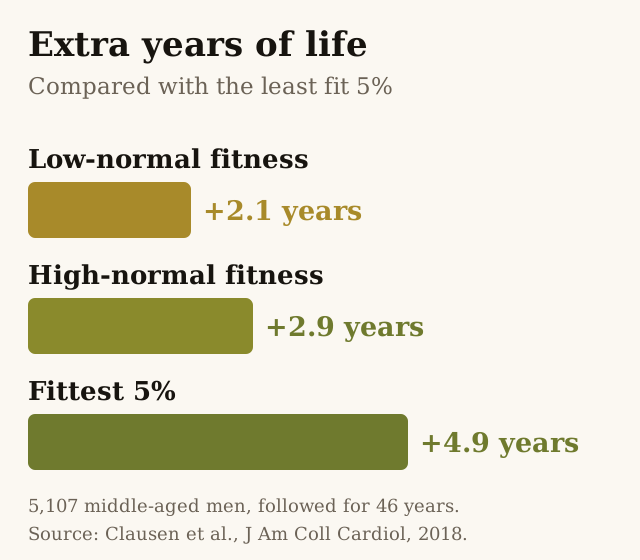
A Danish study followed 5,107 middle-aged men for 46 years. Those in the fittest 5% lived, on average, almost 5 years longer than the least fit 5%.
Because of this body of data, the American Heart Association published a statement in 2016 arguing that fitness should be treated as a vital sign, just like blood pressure. According to the document, it may predict the risk of death better than classic factors such as smoking, high blood pressure, high cholesterol and diabetes.
An important caution when reading this: these are observational studies. They show that people with more fitness live longer, but part of that may come from other things that go along with it, such as having fewer underlying diseases. Even so, the relationship shows up very consistently, in men and women, young and old, and with various ways of measuring.
The biggest gain is in leaving the bottom
The figure I find most useful for everyday life is in the same JAMA meta-analysis. People with low fitness had a 40% higher risk of death than those with intermediate fitness. In other words, you don’t need to become an athlete. Moving from the least fit group to the middle is already associated with a good part of the benefit.
VO₂ falls with age
VO₂ max goes down over the years. A US study measured the same group of 810 adults several times over about 8 years. The decline was 3% to 6% per decade in people in their 20s and 30s and exceeded 20% per decade from age 70. In a US registry of more than 22,000 cardiopulmonary exercise tests, the average value fell about 4 mL/kg/min per decade, and men had higher values than women at every age.
Two things weigh on this decline: the heart, which beats a little less at maximal effort and delivers less oxygen to the muscles with each beat, and the loss of muscle mass.
In the study of 810 adults, the rate of decline was similar between more and less active people. The difference is the starting point. People who train have a higher VO₂ at any age and, with it, more margin before reaching the level where climbing a hill, carrying groceries or playing with grandchildren becomes hard.
How to measure VO₂ max
Cardiopulmonary exercise testing
The test that truly measures VO₂ is the cardiopulmonary exercise test (CPET). You run on a treadmill or pedal a bike with a mask that analyzes the air going in and out. The load increases gradually until your limit, and the device measures how much oxygen you consume at each moment. The test also shows heart rate, the electrocardiogram and the training thresholds, which help set intensity zones.
A standard exercise stress test, without the mask, estimates fitness from the speed and incline you reach. That was the kind of test used in the study of 122,000 patients.
Indirect calorimetry, which measures how much you burn at rest, is a different test with a different purpose. I wrote about it in the post on metabolism and how many calories you burn at rest.
What about your watch’s number?
Watches estimate VO₂ max from heart rate and the pace of your runs or walks. A 2022 review pooled 14 studies that compared watches with the lab test. On average across the group, devices that use exercise data were fairly accurate, but for a single person the error could reach about 10 mL/kg/min either way. Those that use only resting data tended to overestimate.
In a 2025 study of 30 people, the Apple Watch underestimated VO₂ by about 6 mL/kg/min on average, with an average error of 13%.
| Way of measuring | How it works | What it is for |
|---|---|---|
| Cardiopulmonary exercise test | Measures the oxygen in the air you breathe at maximal effort | Knowing the measured value and setting training zones |
| Exercise stress test | Estimates it from the speed and incline reached on the treadmill | Assessing the heart and getting an estimate of fitness |
| Watch | Estimates it from heart rate and running pace | Tracking the trend over the months |
In practice, your watch’s number is useful for tracking whether your fitness is going up or down over the months, always using the same device. For the measured value, the test is cardiopulmonary exercise testing.
How to raise your VO₂ max
VO₂ max responds to training within a few weeks. A 2026 Cochrane review looked at healthy, sedentary adults. Compared with not training, high-intensity interval training raised VO₂ max by about 6 mL/kg/min, in programs of 4 weeks or more.
Interval or continuous training?
Interval training alternates hard stretches with recovery stretches, such as running hard for 1 to 4 minutes and then jogging or walking, repeated a few times. Moderate continuous training means holding a comfortable pace for longer, such as brisk walking, cycling or easy running for 40 to 60 minutes.
Both work. Intervals give a slightly larger gain. In the same Cochrane review, the advantage over continuous training was small, 1.4 mL/kg/min, with low-quality evidence. The bigger difference is time. A 2026 meta-analysis of 69 trials calculated that interval sessions of about 11 minutes already bring 80% of the maximum gain, while continuous training needed about 52 minutes per session to reach 80% of its maximum effect.
A practical way to build your training:
- If you are inactive, start with light to moderate continuous training, such as brisk walking or cycling, several times a week. This phase builds the base and is already linked to the biggest health gain.
- After a few weeks, add one interval session a week, and later two.
- The rest of the week stays light to moderate. Intervals come in as a complement to that volume.
- Strength training comes in too, because loss of muscle mass is one of the causes of VO₂ decline with age.
Intense training does not mix with sudden jumps in load. If you run, increase volume gradually so you don’t trade your fitness gain for an injury, as I explained in the posts on running pain and shin splints.
Before training hard
If you have heart disease, high blood pressure or diabetes, or have been inactive for a long time and want to start intense training, get a medical assessment first. Chest pain, unusual shortness of breath, palpitations or fainting during exercise are reasons to stop and get assessed before you keep training. In many cases, the exercise test itself does both jobs: clearing you to train safely and measuring your starting point.
Conclusion
VO₂ max measures how much oxygen your body can use during effort, and it mainly reflects the capacity of the heart. In studies, it is one of the markers most closely linked to living longer, and the biggest gain is in leaving the least fit group. It falls with age, but it responds well to training: continuous training works, and intervals give a bit more result in less time. For the measured value, the test is cardiopulmonary exercise testing. Your watch is useful for tracking the trend.
Let’s get that VO₂ up! Take care.
Responsible physician: Dr. Gilberto Nering Junior, sports medicine physician, CRM-SP 160822, RQE 142486 (Sports Medicine, Brazil).
This text was not sponsored, is for information only and does not replace an individual assessment. Questions about the content: contact the clinic.
Cover photo: Viktor Bystrov on Unsplash.
Quick questions about VO₂ max
What is VO₂ max?
It is the largest amount of oxygen the body can take in, transport and use per minute at maximal effort. It is measured in milliliters per kilogram per minute and shows your aerobic fitness.
Why is VO₂ max important for health?
Because it is among the factors most closely linked to living longer. In a review of more than 2 million people, the fittest had a 45% lower risk of death than the least fit.
Is my watch’s VO₂ max reliable?
It is useful for tracking whether your fitness is going up or down, always using the same device. For a single person the error can be large, and the measured value comes from cardiopulmonary exercise testing.
How can I raise my VO₂ max?
By training regularly. People who are inactive gain the most at the start. Interval training gives a slightly larger gain in less time, but moderate continuous training also works.
Does VO₂ max fall with age?
Yes. It falls a little each decade in young adults and speeds up with age, exceeding 20% per decade from age 70. People who train start from a higher level and keep more margin for everyday activities.
References
- Clausen JSR, Marott JL, Holtermann A, et al. Midlife Cardiorespiratory Fitness and the Long-Term Risk of Mortality: 46 Years of Follow-Up. J Am Coll Cardiol. 2018;72(9):987-995. doi:10.1016/j.jacc.2018.06.045
- Fleg JL, Morrell CH, Bos AG, et al. Accelerated longitudinal decline of aerobic capacity in healthy older adults. Circulation. 2005;112(5):674-682. doi:10.1161/CIRCULATIONAHA.105.545459
- Kaminsky LA, Arena R, Myers J, et al. Updated Reference Standards for Cardiorespiratory Fitness Measured with Cardiopulmonary Exercise Testing: Data from the Fitness Registry and the Importance of Exercise National Database (FRIEND). Mayo Clin Proc. 2022;97(2):285-293. doi:10.1016/j.mayocp.2021.08.020
- Kodama S, Saito K, Tanaka S, et al. Cardiorespiratory fitness as a quantitative predictor of all-cause mortality and cardiovascular events in healthy men and women: a meta-analysis. JAMA. 2009;301(19):2024-2035. doi:10.1001/jama.2009.681
- Lambe R, O’Grady B, Baldwin M, et al. Investigating the accuracy of Apple Watch VO2 max measurements: A validation study. PLoS One. 2025;20(5):e0323741. doi:10.1371/journal.pone.0323741
- Laukkanen JA, Isiozor NM, Kunutsor SK. Objectively Assessed Cardiorespiratory Fitness and All-Cause Mortality Risk: An Updated Meta-analysis of 37 Cohort Studies Involving 2,258,029 Participants. Mayo Clin Proc. 2022;97(6):1054-1073. doi:10.1016/j.mayocp.2022.02.029
- Mandsager K, Harb S, Cremer P, et al. Association of Cardiorespiratory Fitness With Long-term Mortality Among Adults Undergoing Exercise Treadmill Testing. JAMA Netw Open. 2018;1(6):e183605. doi:10.1001/jamanetworkopen.2018.3605
- Mattioni Maturana F, Zadon NHA, Cocks M, et al. Optimising Exercise Prescription: A Meta-Analysis Examining the Dose Response of Exercise Duration on Cardiorespiratory Fitness Following HIIT and MICT. Sports Med. 2026. doi:10.1007/s40279-026-02528-y
- Molina-Garcia P, Notbohm HL, Schumann M, et al. Validity of Estimating the Maximal Oxygen Consumption by Consumer Wearables: A Systematic Review with Meta-analysis and Expert Statement of the INTERLIVE Network. Sports Med. 2022;52(7):1577-1597. doi:10.1007/s40279-021-01639-y
- Ross R, Blair SN, Arena R, et al. Importance of Assessing Cardiorespiratory Fitness in Clinical Practice: A Case for Fitness as a Clinical Vital Sign: A Scientific Statement From the American Heart Association. Circulation. 2016;134(24):e653-e699. doi:10.1161/CIR.0000000000000461
- Strauss JA, Kirwan R, Ranasinghe C, et al. High-intensity interval training for reducing cardiometabolic syndrome in healthy but sedentary populations. Cochrane Database Syst Rev. 2026;3:CD013617. doi:10.1002/14651858.CD013617.pub2
{“@context”: “https://schema.org”, “@type”: “FAQPage”, “inLanguage”: “en”, “mainEntity”: [{“@type”: “Question”, “name”: “What is VO₂ max?”, “acceptedAnswer”: {“@type”: “Answer”, “text”: “It is the largest amount of oxygen the body can take in, transport and use per minute at maximal effort. It is measured in milliliters per kilogram per minute and shows your aerobic fitness.”}}, {“@type”: “Question”, “name”: “Why is VO₂ max important for health?”, “acceptedAnswer”: {“@type”: “Answer”, “text”: “Because it is among the factors most closely linked to living longer. In a review of more than 2 million people, the fittest had a 45% lower risk of death than the least fit.”}}, {“@type”: “Question”, “name”: “Is my watch’s VO₂ max reliable?”, “acceptedAnswer”: {“@type”: “Answer”, “text”: “It is useful for tracking whether your fitness is going up or down, always using the same device. For a single person the error can be large, and the measured value comes from cardiopulmonary exercise testing.”}}, {“@type”: “Question”, “name”: “How can I raise my VO₂ max?”, “acceptedAnswer”: {“@type”: “Answer”, “text”: “By training regularly. People who are inactive gain the most at the start. Interval training gives a slightly larger gain in less time, but moderate continuous training also works.”}}, {“@type”: “Question”, “name”: “Does VO₂ max fall with age?”, “acceptedAnswer”: {“@type”: “Answer”, “text”: “Yes. It falls a little each decade in young adults and speeds up with age, exceeding 20% per decade from age 70. People who train start from a higher level and keep more margin for everyday activities.”}}]}
{“@context”: “https://schema.org”, “@graph”: [{“@type”: “Organization”, “@id”: “https://clinicanering.com/#org”, “name”: “Clínica Nering”, “url”: “https://clinicanering.com”}, {“@type”: “Person”, “@id”: “https://clinicanering.com/#dr-gilberto”, “name”: “Dr. Gilberto Nering Junior”, “jobTitle”: “Sports Medicine Physician”, “identifier”: “CRM-SP 160822 / RQE 142486”, “worksFor”: {“@id”: “https://clinicanering.com/#org”}, “sameAs”: [“https://www.doctoralia.com.br/gilberto-nering-junior”, “https://www.instagram.com/clinica.nering”]}, {“@type”: “MedicalWebPage”, “@id”: “https://clinicanering.com/blog/en/sports-medicine/vo2-max-what-it-is-why-it-matters/#webpage”, “url”: “https://clinicanering.com/blog/en/sports-medicine/vo2-max-what-it-is-why-it-matters/”, “name”: “VO₂ Max: What It Is, How to Measure It and How to Improve It”, “inLanguage”: “en”, “datePublished”: “2026-10-31T09:00:00+00:00”, “dateModified”: “2026-10-31T09:00:00+00:00”, “author”: {“@id”: “https://clinicanering.com/#dr-gilberto”}, “reviewedBy”: {“@id”: “https://clinicanering.com/#dr-gilberto”}, “publisher”: {“@id”: “https://clinicanering.com/#org”}, “isPartOf”: {“@type”: “WebSite”, “name”: “Clínica Nering Blog”, “url”: “https://clinicanering.com/blog/”}}]}