Also in: Português · Español · Italiano · 中文 · हिन्दी
Main points
- Types of PRP vary with the device and the preparation: the amount of platelets and white cells in the final liquid varies a lot from one clinic to another.
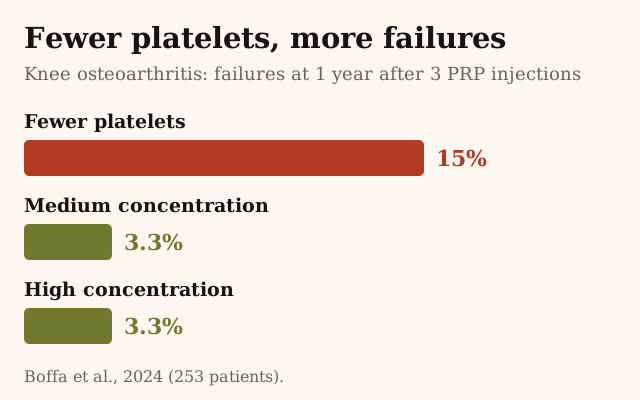
- In the knee, PRP with more platelets tended to work better. In one study, treatment failed in 15% of those who received fewer platelets, compared with 3.3% in the other groups.
- In two recent knee studies, whether or not the PRP contained white cells did not change the result.
- How worn the joint is and the rest of the treatment also change the result, so comparing your PRP with someone else’s tells you little.
- Before having it, ask how the PRP will be prepared and how many injections are planned.
Two people have PRP in the knee. One improves a lot, the other barely at all, and soon someone concludes that “PRP doesn’t work.” Part of the explanation is that there are several types of PRP: the name is the same, but what is in the syringe can change quite a bit from one clinic to another, and even from one device to another.
In the post about what PRP is, I explained how it is made from your own blood. Here I show what changes from one PRP to another, what the studies say about each difference and what to ask before the injection.
What goes into the syringe
One PRP differs from another because each preparation separates the parts of the blood in its own way. Blood has four main parts:
- platelets, tiny cell fragments that help with clotting and store growth factors, substances that send signals to the surrounding tissues. PRP exists because of them;
- white cells, or leukocytes, which defend the body and can release inflammatory substances;
- red blood cells, which give blood its color and which the preparation tries to leave out;
- plasma, the liquid part that carries all of this.
PRP comes from your own blood. To get there, the blood goes through three steps:
- The collected blood goes into a centrifuge.
- As it spins, it separates into layers: red blood cells at the bottom, a thin layer with white cells and lots of platelets in the middle, and plasma on top.
- Then the part richest in platelets is collected.
Each of these steps can be done in different ways. Some methods spin the blood only once; others take the separated plasma and spin it again, to concentrate the platelets further. Some kits use a filter to remove the white cells. And the part collected may include more or less of the middle layer, where the white cells sit. In the end, two similar tubes of blood can turn into two very different liquids.
Three letters to describe types of PRP
In 2012, researchers proposed a simple way to describe PRP, called PAW. Each letter stands for a question:
- P, for platelets: how many were injected;
- A, for activation: how the platelets are made to release what they store, either with a substance added to the tube before the injection or by leaving that to the tissue itself;
- W, for white cells: whether they are present or not.
The authors created the classification because protocols varied too much and were often poorly described, which made it hard to compare one study with another. More than ten years later, these three questions still help you understand what you are getting.
Each device makes a different PRP
A 2019 review brought together the studies that measured the PRP produced by different commercial systems. The amount of platelets and white cells changed a lot from one system to another, and growth factors varied even within the same system. The preparation method and the price also differed widely. The authors concluded that the ideal concentration of each component has not yet been defined for most problems, and that the type of PRP should be chosen according to what is being treated.
A lab study prepared PRP from the blood of the same people in five ways, two manual and three with commercial kits. Double spinning concentrated more platelets and more white cells than single spinning. The growth factors released, however, did not exactly follow the number of cells: each method released more of some and less of others. So saying you had PRP, without knowing how it was prepared, tells you little about what was injected.
The number of platelets matters
If platelets are the active part, it makes sense that their number counts. In knee osteoarthritis, a recent study points that way.
An Italian group followed people with knee osteoarthritis treated with 3 PRP injections for one year and divided the patients by the platelet concentration they received. On average, those who received more platelets improved a little more in pain and function. Treatment failed in 15% of the group with fewer platelets, compared with 3.3% in the medium and high concentration groups.
Another study gave patients with moderate osteoarthritis a standardized PRP with 10 billion platelets and compared it with hyaluronic acid. After one year, those who received PRP were better in pain, function and the distance they could walk without pain. The authors attribute the result to this platelet dose, but the study did not compare different doses, so that part still needs to be confirmed.
The ideal dose has not been defined yet, and it may be different for each tissue. In the knee, PRP with few platelets delivered less in this Italian study. In these studies, the platelets in the PRP were counted before the injection. Not every clinic does this count, but it is worth asking whether it is done.
PRP with leukocytes: are white cells the villains?
White cells defend the body, and some of them release substances that increase inflammation. This led to a long-standing worry that a PRP rich in white cells would inflame the joint more and give a worse result. Many came to prefer leukocyte-poor PRP for the knee.
A 2016 analysis that pooled several studies suggested an advantage for leukocyte-poor PRP. After that, two studies were designed to answer exactly this question. People with knee osteoarthritis received 3 PRP injections, with or without white cells, without knowing which one they had received. At one year, improvement was similar in both groups. In the 2022 study, mild reactions such as pain and swelling appeared in 12% of those who received PRP with white cells and in 5% of those who received it without them, a difference that was not significant.
Today, in the knee, the presence of white cells seems to matter less than once thought, while the number of platelets made a difference in the Italian study. For other problems, the ideal type of PRP is still an open question.
What to expect after the injection
The most common reaction to PRP in the knee stays in the knee itself: temporary pain and swelling after the injection. In the 2016 analysis, these reactions were more frequent with PRP than with hyaluronic acid, but they did not seem to depend on white cells. In the two most recent studies, no one had a serious side effect.
A sorer knee in the first few days is part of what can happen and does not mean the treatment failed, and knowing this beforehand saves you a scare. But fever, marked redness, warmth in the knee or pain that gets worse each day instead of better means you should contact your doctor the same day. What to do before and after the injection to get through this phase more easily is in the post on PRP care.
One injection or three?
The platelet study and the two white cell studies used 3 injections, and in one of them the interval was one week. One study compared three injections, a single injection and saline. The three injections gave a better result than one at 6 and 12 months. At 24 months, the difference between the groups had disappeared.
In practice, the number of injections is also part of the “type” of PRP: before comparing results, it helps to know whether the person had one injection or a series. And since the effect fades over time, this needs to be part of the conversation from the start.
Your knee counts too
A 2026 review sorted what changes the result of PRP into three groups of factors: biological, technical and those of the problem being treated. In the three-injection study, the best results appeared in people with mild osteoarthritis and, in the first 6 months, in those aged 51 to 65. And the main studies I cited here included people with mild to moderate osteoarthritis. Advanced osteoarthritis was left out, and these results do not automatically apply to it. The rest of the treatment also counts, because PRP comes in as a complement, alongside strengthening and weight control, not in their place.
The two people from the start may have received different PRPs, may have different degrees of joint wear and may or may not have followed the rest of the treatment. Any of these differences can change the result.
Why the studies disagree
If each PRP is different, the studies are also testing different things under the same name. A 2017 review analyzed the clinical studies of PRP in orthopedics and found a basic problem: only about 10% described the preparation in a way that would allow the method to be repeated. Most also did not report what was in the PRP they injected.
The 2026 review pointed to the same flaw as one of the biggest limitations of the field. That is why the question “Does PRP work?” has different answers depending on the PRP, the problem and the study you look at.
What to ask before having PRP
Before the injection, it is worth asking your doctor what your PRP will be like. These questions help you know what you will receive:
- what problem the PRP is being recommended for, and whether that indication is among those allowed by Brazil’s Federal Council of Medicine (CFM);
- how the PRP will be prepared: which system, one or two spins;
- whether the platelets in the PRP are counted before the injection;
- whether the PRP will contain white cells or not;
- how many injections are planned, and at what interval;
- what to do before and after each injection;
- what the expected benefits, limits and alternatives are, which must be in the consent form.
For the knee, I wrote a whole post on PRP for osteoarthritis, with what to expect and for how long. There you will also find the guidelines that recommend PRP and those that advise against it.
What Brazil’s CFM says
CFM Resolution 2.464/2026 allows PRP as a complementary treatment in four situations: knee osteoarthritis, lumbar disc disease, lateral epicondylitis of the elbow (tennis elbow) and meniscus repair. The procedure must be performed by a physician, only with the patient’s own blood and with a signed consent form. The resolution also prohibits presenting PRP as a cure, guaranteed regeneration or a substitute for indicated surgery, and mixing PRP with stem cells, bone marrow or fat outside research.
What changes from one type of PRP to another
The PRP you receive depends on the device, the preparation, the number of platelets and the number of injections. In the knee, the number of platelets and the series of three injections made a difference, each in one study, and white cells mattered less than expected. The result also depends on your knee and on the rest of the treatment. Since many studies don’t even describe the PRP they used, the questions above help you know what goes into your syringe. Here is what each difference showed in the knee studies:
| What changes in the PRP | What the studies showed in the knee |
|---|---|
| Number of platelets | with few platelets, treatment failed in 15%, compared with 3.3% with more platelets |
| White cells | similar improvement with and without them in two one-year studies |
| Number of injections | 3 injections were better than 1 at 6 and 12 months; at 24 months, no difference |
| Preparation method | in the lab, double spinning concentrated more platelets and white cells than single spinning |
| Degree of osteoarthritis | better results in mild osteoarthritis; advanced osteoarthritis was left out of the studies |
Ask before the injection, and see you next time!
Responsible physician: Dr. Gilberto Nering Junior, sports medicine physician, CRM-SP 160822, RQE 142486 (Sports Medicine, Brazil).
This text was not sponsored, is for information only and does not replace an individual assessment. Questions about the content: contact the clinic.
Cover photo: Diana Polekhina on Unsplash.
Quick questions about types of PRP
What are the types of PRP?
Types of PRP differ in the number of platelets, the presence or absence of white cells and the preparation method. These three things vary a lot from one device to another and can change the result.
Does PRP with more platelets work better?
In knee osteoarthritis, a study of 253 patients suggests it does. Treatment failed in 15% of the group with fewer platelets, compared with 3.3% in the groups with more platelets.
Is PRP with leukocytes (white cells) worse?
In the knee, two studies that compared PRP with and without white cells found no difference in results at one year. In one of them, mild reactions were slightly more common with white cells, with no significant difference.
How many PRP injections are needed?
Most of the knee studies I cited used 3 injections. In one study, three injections worked better than one at 6 and 12 months, but the difference disappeared at 24 months.
What should I ask before having PRP?
What the indication is, how the PRP will be prepared, whether the platelets are counted, whether it will contain white cells, how many injections are planned and what the benefits, limits and alternatives are.
References
- Bansal H, Leon J, Pont JL, et al. Platelet-rich plasma (PRP) in osteoarthritis (OA) knee: Correct dose critical for long term clinical efficacy. Sci Rep. 2021;11(1):3971. doi:10.1038/s41598-021-83025-2
- Boffa A, De Marziani L, Andriolo L, et al. Influence of Platelet Concentration on the Clinical Outcome of Platelet-Rich Plasma Injections in Knee Osteoarthritis. Am J Sports Med. 2024;52(13):3223-3231. doi:10.1177/03635465241283463
- Chahla J, Cinque ME, Piuzzi NS, et al. A Call for Standardization in Platelet-Rich Plasma Preparation Protocols and Composition Reporting: A Systematic Review of the Clinical Orthopaedic Literature. J Bone Joint Surg Am. 2017;99(20):1769-1779. doi:10.2106/JBJS.16.01374
- Conselho Federal de Medicina. Resolução CFM nº 2.464, de 2 de julho de 2026. Regulamenta o uso de plasma rico em plaquetas como procedimento médico adjuvante no tratamento de condições osteomusculares específicas. Diário Oficial da União. 15 jul 2026; Seção 1:70. Text of the resolution (in Portuguese)
- DeLong JM, Russell RP, Mazzocca AD. Platelet-rich plasma: the PAW classification system. Arthroscopy. 2012;28(7):998-1009. doi:10.1016/j.arthro.2012.04.148
- Di Martino A, Boffa A, Andriolo L, et al. Leukocyte-Rich versus Leukocyte-Poor Platelet-Rich Plasma for the Treatment of Knee Osteoarthritis: A Double-Blind Randomized Trial. Am J Sports Med. 2022;50(3):609-617. doi:10.1177/03635465211064303
- Oh JH, Kim W, Park KU, et al. Comparison of the Cellular Composition and Cytokine-Release Kinetics of Various Platelet-Rich Plasma Preparations. Am J Sports Med. 2015;43(12):3062-70. doi:10.1177/0363546515608481
- Oudelaar BW, Peerbooms JC, Huis In ’t Veld R, et al. Concentrations of Blood Components in Commercial Platelet-Rich Plasma Separation Systems: A Review of the Literature. Am J Sports Med. 2019;47(2):479-487. doi:10.1177/0363546517746112
- Riboh JC, Saltzman BM, Yanke AB, et al. Effect of Leukocyte Concentration on the Efficacy of Platelet-Rich Plasma in the Treatment of Knee Osteoarthritis. Am J Sports Med. 2016;44(3):792-800. doi:10.1177/0363546515580787
- Romandini I, Boffa A, Di Martino A, et al. Leukocytes Do Not Influence the Safety and Efficacy of Platelet-Rich Plasma Injections for the Treatment of Knee Osteoarthritis: A Double-Blind Randomized Controlled Trial. Am J Sports Med. 2024;52(13):3212-3222. doi:10.1177/03635465241283500
- Rothrauff BB, Featherall JT, Uppstrom TJ, et al. Platelet-Rich Plasma in the Treatment of Musculoskeletal Disease in 2025 and Beyond. Am J Sports Med. 2026;54(8):2058-2074. doi:10.1177/03635465251395284
- Yurtbay A, Say F, Çinka H, et al. Multiple platelet-rich plasma injections are superior to single PRP injections or saline in osteoarthritis of the knee: the 2-year results of a randomized, double-blind, placebo-controlled clinical trial. Arch Orthop Trauma Surg. 2022;142(10):2755-2768. doi:10.1007/s00402-021-04230-2